


Making partner changes how money shows up. Here’s how to make sure strong income turns into lasting wealth.
By Courtney Hoffman, CFP®, AAMS™ EverPar Advisors
Most of the partners we work with can tell you their gross number without thinking. Ask what they actually spend in a year, and the answer usually takes a lot longer.
That gap matters. Once you make partner, you’re likely earning more than you ever have, but your balance sheet doesn’t always reflect it. Your pay arrives in a different shape, your taxes move from payroll to quarterly payments, and your income, your capital and your retirement all end up depending on the same firm.
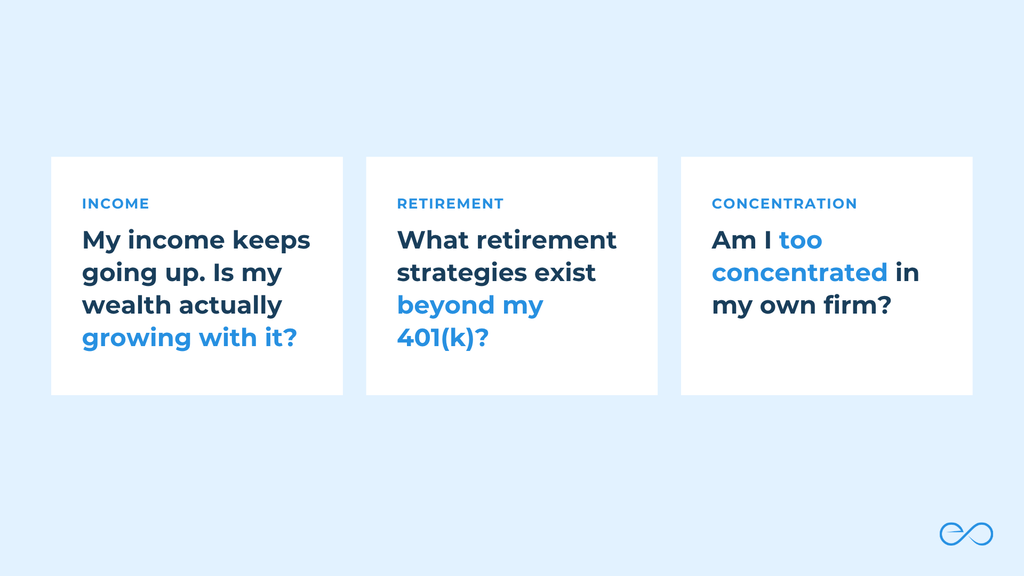
Tom Flanagan and I recently sat down to work through the three questions we hear most often from attorneys, along with the steps we’d take on each.
How partner income differs from a W-2 paycheck
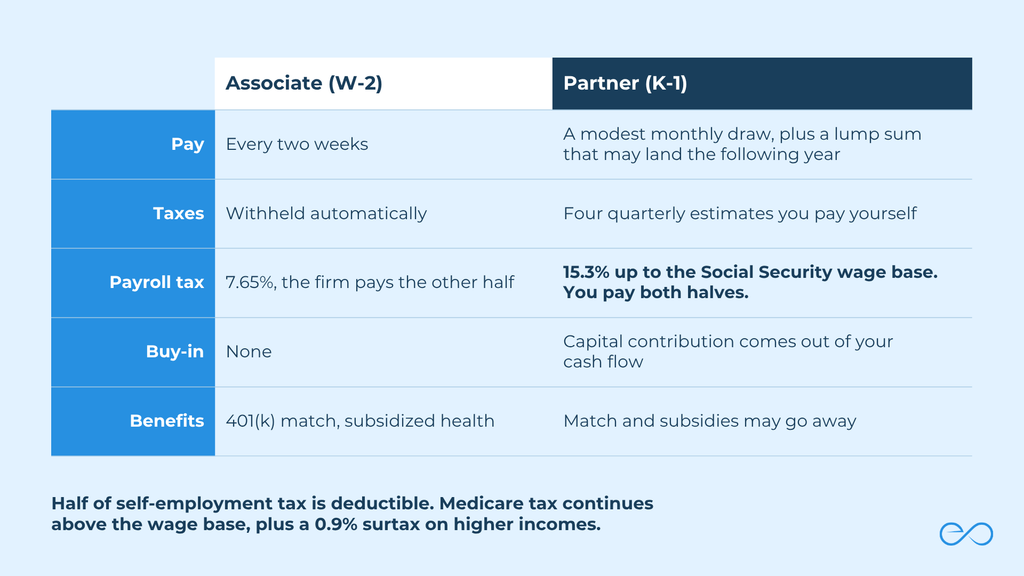
As an associate, a paycheck arrived every two weeks with taxes already taken out. As a partner receiving a K-1, your income changes shape even as it grows. The monthly draw is usually set deliberately below what you expect to earn for the year, and the rest arrives as a lump-sum distribution that’s sometimes calculated after the year closes and paid the following year.
So the annual number climbs while monthly cash flow goes down. A few things drive that:
- The buy-in starts, whether it’s financed with a bank loan or held back straight out of your distributions.
- Tax withholding ends. Instead of money leaving invisibly every two weeks, you send four quarterly estimates yourself.
- Payroll tax roughly doubles. Associates pay 7.65% and the firm pays a matching 7.65%, but partners pay both halves as self-employment tax: 15.3% up to the Social Security wage base and 2.9% for Medicare above it, plus the 0.9% Additional Medicare Tax on higher incomes.
- You may lose the 401(k) match associates receive, along with subsidized health, dental or other voluntary benefits.
Half of self-employment tax is deductible, so it isn’t a clean doubling. It’s still thousands of dollars a year that used to be someone else’s line item. The first year tends to be the hardest, because your estimates are based on expected income while your draw is still modest and your capital contribution is due at the same time.
Start with a baseline built on after-tax dollars
The first step is a mindset change. Pull twelve months of actual spending and split it between essential and discretionary expenses. It doesn’t have to be a budget, just a baseline.
Planning against the gross K-1 figure is where this exercise usually falls apart, because the gross amount is misleading. Work from the bottom up using after-tax dollars instead.
Then count your capital contribution as savings. It’s an illiquid asset, but money going into that account is still building your wealth. Partners routinely feel like they’re saving nothing while a meaningful share of their net worth sits in their capital account, so it needs to show up correctly in the plan and in how you think about your progress.
Give every distribution a job
Live on your monthly draw. Treat the draw like a salary, and treat each distribution as money that needs instructions before it lands in your checking account.
A good standing rule sends a set amount to your tax reserve, a set amount to your capital obligation and a set amount to long-term savings like your 401(k). What’s left goes toward household living expenses. A distribution can also be earmarked for a specific goal, like travel or another investment. Without a rule, it gets absorbed into your lifestyle, and that’s very easy to get used to.
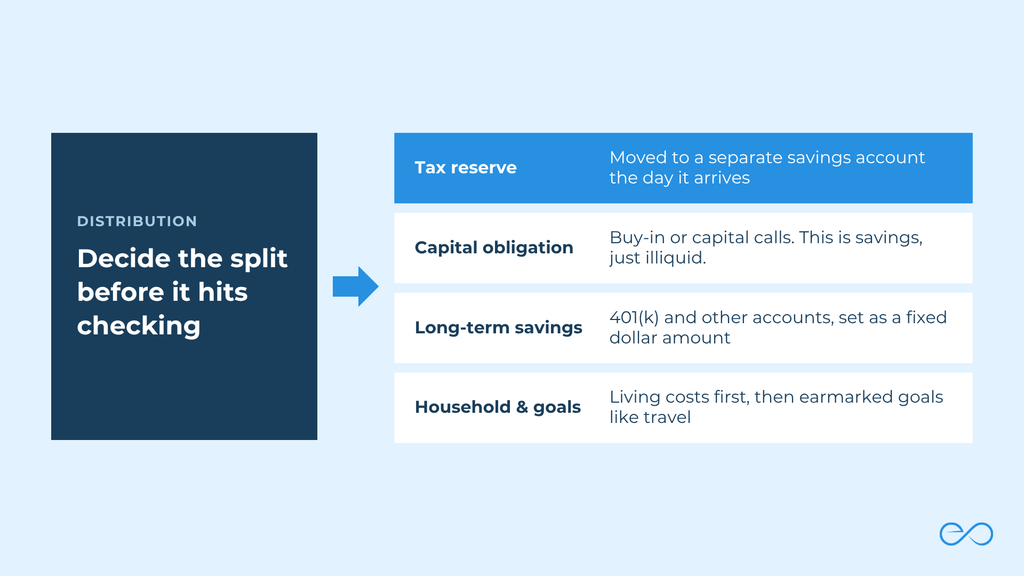
Two habits make the split stick. First, move the tax reserve into a separate high-yield savings account the day the distribution arrives. When the estimate is due, the money is already set aside and paying it is just a transfer between accounts.
Second, set your savings as a fixed dollar amount from the draw rather than a percentage. The 2026 401(k) employee deferral limit is $24,500, which works out to about $2,042 a month. Deciding on that number up front gets you to the max, with no leftovers to sort out at year end.
How estimated taxes work for law firm partners
Compute your estimate at the beginning of the year, and know the safe harbor rules. Generally, paying at least 100% of last year’s tax keeps you clear of an underpayment penalty. That rises to 110% if your prior-year AGI was over 150,000(75,000 if married filing separately), which applies to most partners. Treat that as your floor. Even if the firm has a blowout year, paying the safe harbor amount keeps you out of the penalty zone.
Quarterly estimates are due in April, June, September and the following January. Four payments are the minimum, so if paying monthly is easier to manage, you can do that instead.
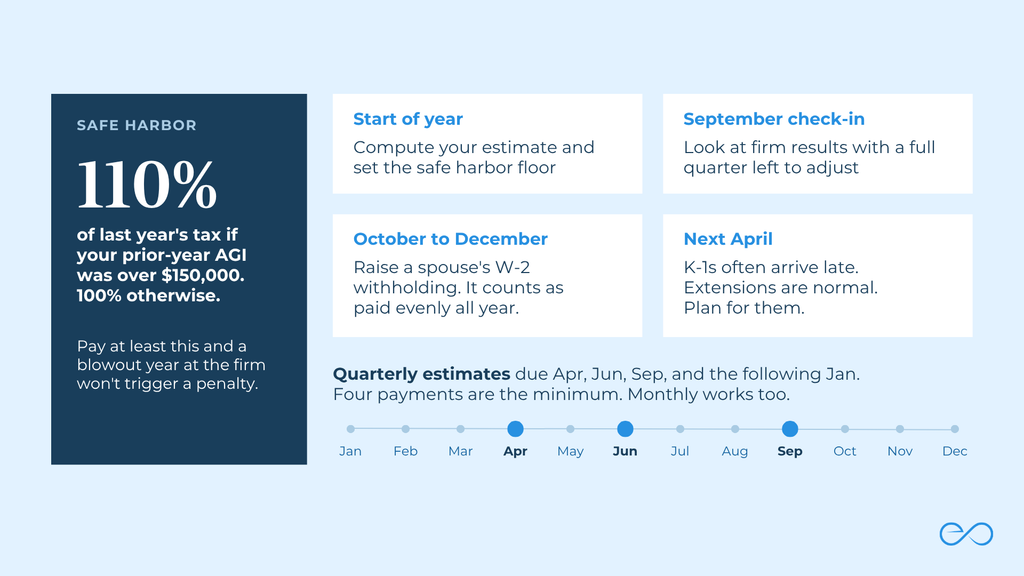
If your spouse earns W-2 income, you have another tool that a lot of people forget about. W-2 withholding is treated as if it were paid evenly across the whole year, no matter when it actually happens. Raising your spouse’s withholding late in the year can cure an underpayment that an estimated payment can’t, because once a quarterly deadline passes, that window is closed.
Give yourself a sanity check in September rather than waiting until December. By then you’ll have a good sense of how the firm is tracking, and you’ll still have a full quarter to adjust, including raising that withholding. Wait until December and most of those planning opportunities are gone.
Finally, expect your K-1 to arrive late. Many partners reach April 15 without their K-1 for the prior year, file an extension, and pay what amounts to an estimate of an estimate. That’s normal, and it’s much easier when you’ve planned for it ahead of time.
Retirement strategies beyond the 401(k)
Most attorneys assume the 401(k) is the only retirement strategy available to them. For a partner earning well into six figures, the elective deferral shelters only a small share of income, and there’s usually more room. Most of it depends on decisions made at the firm level.
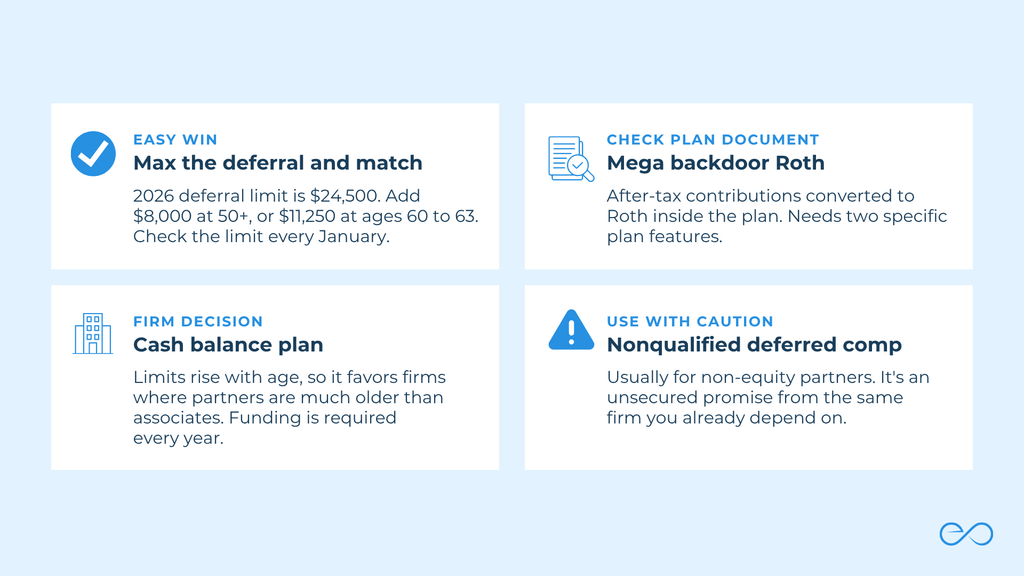
Max the deferral and the match
Start with the low-hanging fruit. Confirm you’re making the full elective deferral and receiving the maximum match or profit-sharing allocation your plan provides.
In our experience, many people think they’re maxed out when they aren’t, because the limit moves almost every year. If you contribute a percentage of a salary that hasn’t changed, you can fall behind the limit without noticing. Check it every January. For 2026, the employee deferral limit is $24,500. If you’re 50 or older, you can add an $8,000 catch-up contribution, and between ages 60 and 63, a higher catch-up of $11,250 applies instead.
Profit sharing is the next layer, and it’s where larger dollars can go in. Many firm plans use a cross-tested formula (often called new comparability), which tilts profit-sharing allocations by group or by age. Ask which formula your plan uses. You may be getting more than you thought, or less than you assumed.
Check whether your plan allows a mega backdoor Roth
A mega backdoor Roth lets you make after-tax contributions to your 401(k) and convert them to Roth, so future growth is tax-free. It’s similar to a backdoor Roth IRA, but it happens inside the plan. Your plan needs two features for it to work:
- The plan accepts after-tax contributions.
- The plan permits either in-plan Roth conversions or in-service distributions, which let you roll the money to a Roth IRA outside the plan.
A plan with only one of the two won’t get you there. If the plan allows after-tax contributions but offers no way to convert them, that money sits in the plan, and its growth is taxed as ordinary income when you eventually withdraw it. Confirm both features exist before you contribute after-tax dollars. It’s a simple yes or no in the plan document, and your third-party administrator, office manager or HR department can usually answer it quickly.
Your available room is personal, so you won’t find it published anywhere. The 2026 total limit is $72,000, and it counts your deferral, what the firm contributes and your after-tax contributions together. That means a partner at a generous firm has less room, and a partner at a leaner firm has more.
Here’s an example. Start with the $72,000 limit and subtract a maxed-out deferral of $24,500. If the firm contributes $17,500 through the match and profit sharing, that leaves $30,000 you could contribute after-tax and convert right away. If you’re 50 or older, catch-up contributions sit on top of the $72,000, so making them doesn’t shrink your mega backdoor room.

There’s one more risk to know about. If associate participation in the plan is low, nondiscrimination testing can force after-tax contributions to be refunded to you. Ask whether the plan is a safe harbor plan and how it has tested over the last couple of years so you can plan accordingly.
Consider whether a cash balance plan fits the firm
A cash balance or other defined benefit plan is another lever, and this one is based on age. Contribution limits scale with how close you are to retirement, because the contribution is whatever amount actuarially funds a target benefit by retirement. That’s why a partner in their fifties can shelter a multiple of what a partner in their thirties can, and why the math favors partnerships where the partners are meaningfully older than the associates.
The firm’s age spread decides whether the plan is worth adopting at all. A cash balance plan is almost never a standalone. It’s usually paired with a 401(k) and profit-sharing plan to pass coverage testing, and that pairing usually means raising staff contributions.
Know the costs before you commit. Funding is an obligation every year, and these plans are expected to stay in place for several years. If your partnership’s profits are volatile, pause before adopting one, because unwinding a plan early creates unwanted costs and can draw scrutiny from the IRS.
Be cautious with nonqualified deferred compensation
The first three options put more money to work. Nonqualified deferred compensation comes with a warning. It doesn’t apply to everyone, because equity partners are typically self-employed, so true deferred compensation is usually limited to non-equity partners or very specific arrangements.
If your firm offers it, understand what you’re getting. A deferred comp account is a promise, and the money isn’t held for you. You’re an unsecured creditor of the firm, and your income, capital account and retirement are already tied to that same firm. A heavy deferral adds one more exposure to the same counterparty.
The election is also close to permanent. Under Section 409A, you choose how much to defer before you earn the money, and changing the payout schedule later is heavily restricted. Payouts often trigger when you separate from the firm, so ask yourself what your tax rate will be then, and whether you’re comfortable being a creditor to a firm where you no longer have a say.
If you’re offered a plan, ask how it’s funded, what triggers a payout, and what happens if the firm is sold or merges. Then decide how much of your retirement you want riding on one firm.
What concentration risk looks like for a law firm partner
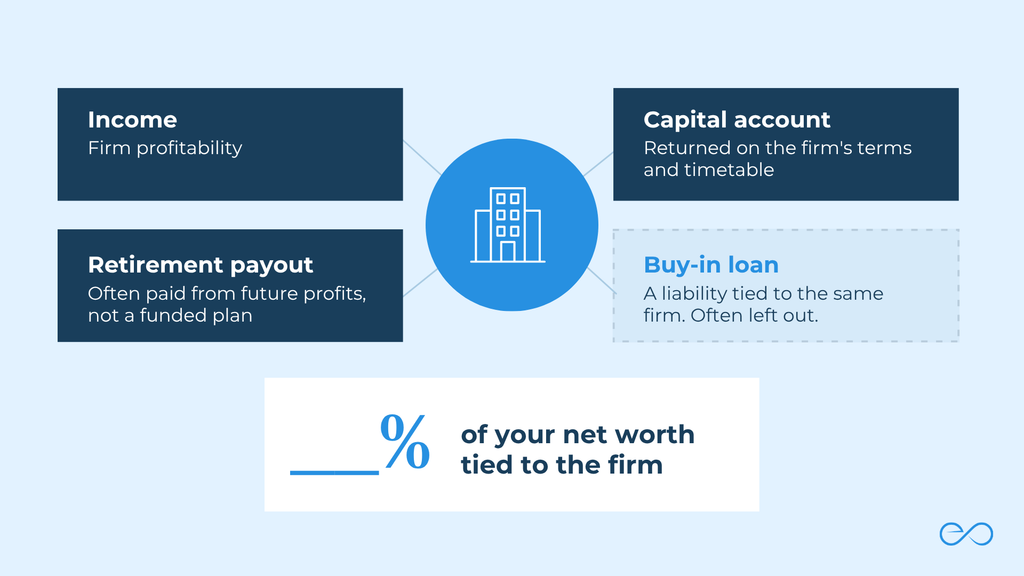
As an owner, your income, your capital and your retirement all point back to the same place. That has a name: concentration risk.
This isn’t a prediction that your firm will fail. The point is that three things your household depends on are tied to one business, and most people have never added them up. Your income depends on the firm’s profitability. Your capital account comes back on the firm’s terms and timetable. And at many firms, your retirement payout is a promise paid from future profits rather than a funded plan.
Four steps to manage concentration risk
We handle it in four steps: measure it, read the agreement, build outside the firm, and protect the household with the right insurance.
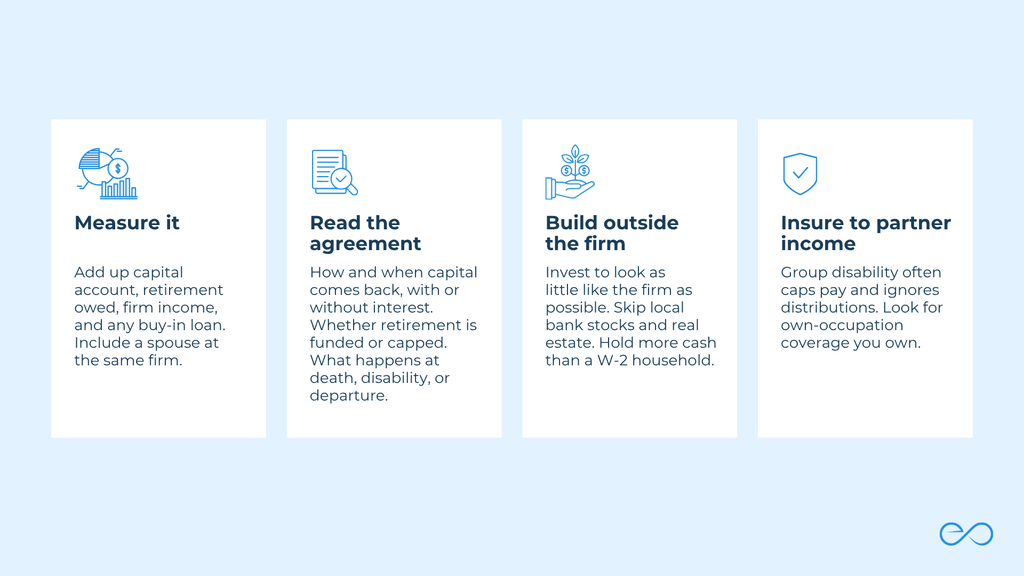
1. Measure it
Write down what your capital account is worth, what the firm will owe you when you withdraw, and what share of your household income comes from the firm. Then add a fourth number partners almost never count: the buy-in loan balance, if it’s still outstanding. It’s a liability created by the same counterparty, which means your exposure is levered. If your spouse also works at the firm, or at a business that depends on the same regional economy, include that too.
Express the total as a share of your net worth rather than in dollars. Dollars sound like an achievement. A percentage sounds like a position.
2. Read the agreement
Read the partnership agreement itself instead of relying on how it was described to you, and look for answers to four questions:
- What triggers the return of your capital, over how long, and does it carry interest? A capital account returned over five years with no interest is worth meaningfully less than the balance on your statement.
- Is the retirement obligation funded or paid from future profits, and is it capped? Many firms cap total annual retirement payouts as a share of revenue. If yours does, you’re exposed to future profitability and you’re also in line behind every partner who retires near you, so ask how many partners are within five years of you.
- What happens at death or disability? Whether the capital account accelerates or pays on the normal schedule can be the difference between a family being fine and a family waiting four years.
- Are there forfeiture or clawback provisions if you leave early or go to a competitor?
3. Build outside the firm
Build everything outside the firm to look as little like the firm as possible. Start by treating your income like the asset it actually resembles. A partner at a stable, diversified firm has bond-like income and can carry more risk in a portfolio. A partner whose firm leans on a few large clients or one practice area has equity-like income and may want more fixed income than their age alone would suggest. Very few people apply that framework to themselves.
Watch for doubling down without noticing. Bank stocks, local commercial real estate and anything else tied to the same local economy your firm’s clients depend on is more of the same bet under a different label.
Hold more cash than a W-2 household at the same income. Your capital account can’t be sold, so liquidity has to come from outside it. And diversify your timeline along with your assets. You can’t sell the exposure, but you can avoid planning to step back at the moment the firm is under the most stress.
4. Insure to partner income
Size your insurance to partner income, not to the group plan. Group disability coverage is built for associates and quietly fails partners. It usually replaces a percentage of salary up to a monthly dollar cap, which a partner hits immediately, and it often ignores distributions as income entirely.
The definition of disability decides everything. Own-occupation coverage pays a litigator who can no longer try cases. Any-occupation coverage doesn’t, if that person could do something else. Many partners assume they have the first when they actually have the second.
Who pays the premium matters too. If the firm pays, the benefit is generally taxable. An individually owned policy paid with after-tax dollars pays out tax-free, so your real replacement ratio can be better than the headline percentage, and the policy goes with you if you leave.
Life insurance has a second job here as well. Beyond replacing income, it covers the years your family might wait for your capital account to be paid out after a premature death or disability.
Where to start
If you do one thing this week, calculate the share of your net worth that’s tied to your firm. Once you know that number, every other decision gets easier.
Being an owner is a great position to be in. The goal is making sure your family isn’t relying on it alone.
If you’d like help working through any of this, book a free foundation session with our team at everpar.com. We’ll look at your overall picture, including investments, taxes and how your partner income fits together, and build a plan for your family.
Frequently asked questions
Do law firm partners pay self-employment tax?
Generally, yes. Equity partners are typically treated as self-employed, so they pay both halves of Social Security and Medicare tax: 15.3% up to the Social Security wage base and 2.9% above it, plus a 0.9% Additional Medicare Tax on higher incomes. Half of self-employment tax is deductible.
How can a partner avoid an underpayment penalty on estimated taxes?
Pay at least 100% of last year’s total tax through estimates and withholding, or 110% if your prior-year AGI was over 150,000(75,000 if married filing separately). Increasing a spouse’s W-2 withholding late in the year also helps, because withholding counts as if it were paid evenly all year.
Can law firm partners do a mega backdoor Roth?
They can if the firm’s 401(k) plan allows after-tax contributions and either in-plan Roth conversions or in-service distributions. Your room is the 2026 total limit of $72,000 minus your own deferral and whatever the firm contributes.
What counts toward concentration risk at my firm?
Add up your capital account, the retirement payout the firm will owe you, the income you receive from the firm, and any outstanding buy-in loan. Include a spouse’s income if they work at the same firm or in the same regional economy, then express the total as a share of your net worth.
EverPar Advisors is a Registered Investment Adviser registered with the U.S. Securities and Exchange Commission. Registration does not imply a certain level of skill or training. This article is for informational and educational purposes only. It is not intended as investment, tax, or legal advice. Consult with a qualified professional before making any investment decisions. Past performance is not indicative of future results.
All information has been obtained from sources believed to be reliable, but its accuracy is not guaranteed. There is no representation or warranty as to the current accuracy, reliability, or completeness of, nor liability for, decisions based on such information and it should not be relied on as such.
The information provided is for educational and informational purposes only and does not constitute investment advice and it should not be relied on as such. It should not be considered a solicitation to buy or an offer to sell a security. It does not take into account any investor’s particular investment objectives, strategies, tax status or investment horizon. You should consult your attorney or tax advisor.
The views expressed in this commentary are subject to change based on market and other conditions. This commentary may contain certain statements that may be deemed forward-looking statements. Please note that any such statements are not guarantees of any future performance and actual results or developments may differ materially from those projected.
The information contained above is for illustrative purposes only.